Manufacturing methods for rings
Rings made from this composite are produced using powder metallurgy rather than casting or forging. Tungsten powder is mixed with binder powder to achieve the required composition. This mixture is then compacted under high pressure into a ring-shaped form.
The compacted ring is sintered in a controlled atmosphere furnace at temperatures between approximately 1400 and 1600°C. During sintering, the binder phase melts and flows, allowing tungsten particles to bond together and achieve near-full density. The result is a rigid, fully hardened ring blank.
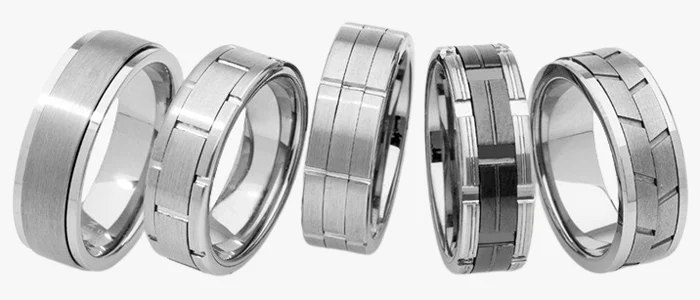
Once sintered, the material is extremely difficult to machine. Conventional cutting tools are ineffective, and any material removal requires diamond abrasives. For this reason, ring dimensions, profiles, and features such as grooves or inlays are determined during manufacturing rather than added later.
In our workshop, tungsten rings arrive from suppliers as finished products. Our work focuses on laser engraving, surface finishing where applicable, and quality inspection rather than structural modification.
Workshop experience and real-world wear
We engrave and polish tungsten rings daily, and we also see rings return after months or years of wear. This exposure provides a clear picture of how the material behaves outside controlled conditions.
Surface wear develops very slowly. Polished finishes retain their reflectivity for extended periods, and brushed finishes maintain their texture far longer than comparable finishes on titanium or precious metals. The material is not scratch-proof, but it is highly scratch resistant. When marks do occur, they are usually the result of contact with materials of similar hardness, such as ceramics or hardened steel.
Impact behaviour highlights further tungsten rings pros and cons. The composite is extremely hard but not tough in the metallurgical sense. It does not bend or absorb shock energy. Under sharp impact, stress concentrates rather than distributing through plastic deformation. In rare circumstances, this can lead to chipping or fracture.
In practice, normal office work, driving, and household activities present little risk. Repeated heavy impacts, dropping the ring onto hard surfaces, or trapping it between rigid objects increase the likelihood of damage. These outcomes reflect material behaviour rather than manufacturing defects.
Chemical resistance and surface stability
The material does not rust and does not oxidise in normal atmospheric conditions. It is resistant to water, sweat, and most common household substances. The binder phase remains the most chemically vulnerable component.
Extended or repeated exposure to strong oxidising agents such as bleach can affect surface appearance over time. Alcohol-based hand sanitisers, when used excessively without rinsing, have also been observed to cause subtle surface changes in some cases. These effects occur through gradual chemical interaction with the binder rather than the tungsten phase itself.
Where chemical exposure is frequent or unavoidable, darker metal alternatives such as tantalum rings may be more suitable. In situations where greater impact tolerance is required, cobalt rings offer different performance characteristics.
Sizing limitations and fitting considerations
Rings made from this material cannot be resized. This is a physical limitation, not a commercial decision. The hardness prevents stretching or compression, and the brittle nature means cutting and rejoining would result in fracture rather than controlled deformation.
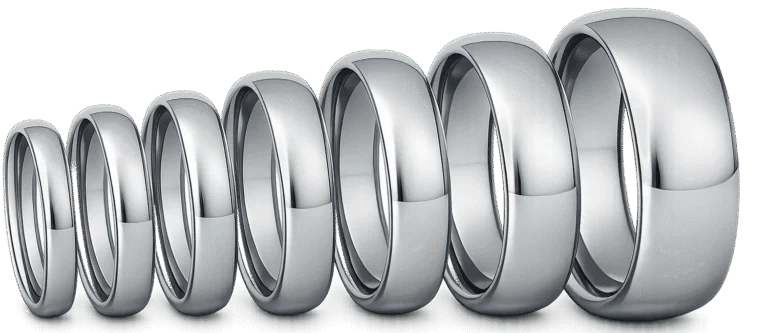
This constraint affects all tungsten wedding rings and makes accurate sizing before manufacture essential. Once produced, the size is fixed. Ring width also influences perceived fit and should be considered during sizing.
Engraving behaviour in practice
Internal engraving performs exceptionally well using fibre laser systems. The laser produces a high-contrast dark mark that remains stable and legible over time. The engraving mechanism involves controlled surface modification rather than material removal.
Because the composite is dense and homogeneous, engraving depth and appearance are consistent. Fine lettering and detailed designs reproduce reliably when set up correctly, as outlined in our laser engraving guide.
External engraving is not offered in our workshop. Creating recessed external features introduces stress concentration points at the edges of the engraving, increasing the risk of chipping if the area catches during wear. This is a design decision informed by material behaviour rather than an engraving limitation.
Design, appearance, and finishes
The natural colour is a dark grey that can appear gunmetal under certain lighting. The colour comes from the material itself rather than coatings or surface treatments.
Polished finishes produce high reflectivity and retain that appearance for extended periods due to surface hardness. Brushed finishes create a satin texture that diffuses light and reduces the visibility of minor surface marks. Both finishes maintain defined edges and profiles over time, as the material does not deform under normal wear.
These characteristics underpin the appeal of tungsten wedding rings for wearers who value shape retention and long-term surface stability. Design options in men’s tungsten rings UK collections reflect this approach, relying on manufacturing precision rather than post-production modification.