How This Guide Is Written
This guide reflects practical trade conditions observed through workshop handling, customer servicing, and material sourcing in the UK jewellery market over many years. It prioritises how materials behave in ownership over how they are promoted at the point of sale.
What Palladium Is Used For Today
Palladium is a precious metal within the platinum group of metals, alongside platinum, rhodium, iridium, ruthenium, and osmium. Discovered in 1803, it is naturally white, chemically stable, and highly resistant to corrosion.
Today, palladium is primarily an industrial material. Most global demand comes from non-jewellery applications, particularly automotive catalytic converters, where palladium helps reduce harmful exhaust emissions. It is also used in electronics, dentistry, chemical processing, and hydrogen-related technologies.
Jewellery now represents a small and declining share of total palladium usage.
Palladium in Jewellery: Why It Became Popular
Palladium has been used in jewellery for over a century, but it was not a mainstream wedding metal until relatively recently.
Its use increased during periods when platinum was restricted or difficult to obtain, particularly during wartime. Later, in the late 1990s and early 2000s, palladium gained popularity as platinum prices rose sharply. At that time, palladium offered:
For several years, this made palladium an attractive choice for wedding rings, especially men’s bands.
That economic advantage no longer exists in the same way.
Palladium and Platinum: Physical Differences That Matter
Although palladium and platinum sit in the same metal group, they behave differently in daily wear.
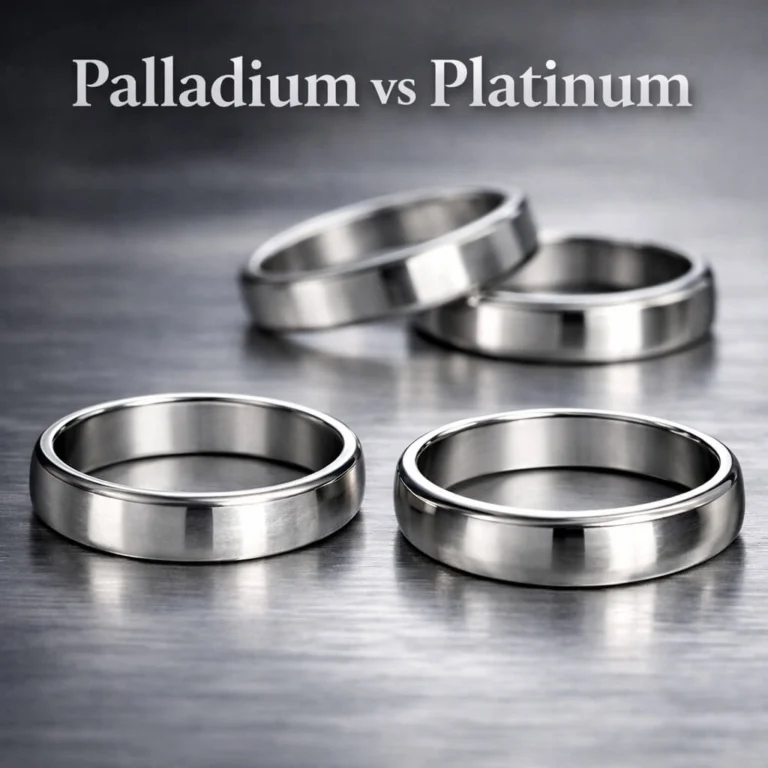
Palladium has a much lower density than platinum, resulting in a significantly lighter ring. Platinum is denser and has a heavier, more substantial feel on the hand. Both metals are naturally white, tarnish resistant, and hypoallergenic.
From a long-term perspective, platinum is more resistant to deformation and is more widely understood across the jewellery trade. This affects not only how a ring wears, but also how easily it can be resized or repaired decades later.
Palladium vs Platinum: Price and Value in 2026
The historical narrative that “palladium is cheaper than platinum” is no longer reliable.
As of January 2026, platinum is trading at a higher spot price than palladium. However, spot price alone does not determine the finished cost of a wedding ring.
Platinum should now be viewed as a premium but stable option, while palladium pricing is more variable and less predictable when applied to jewellery manufacture.
Why Ring Prices Don’t Mirror Spot Prices
The relationship between precious-metal spot prices and finished ring costs is not linear.
Even when palladium trades below platinum, the retail price of a palladium ring can remain high because:
Labour costs are similar regardless of metal choice
Manufacturing losses occur during casting, resizing, and finishing
Workshop setup costs are spread across production volume
Platinum benefits from higher trade throughput and established supply chains
Lower-volume materials such as palladium do not benefit from the same economies of scale. As a result, any apparent spot-price advantage can be reduced or eliminated at the finished-ring level.
The Serviceability Gap: A Critical Consideration
One of the most important changes affecting palladium today is long-term serviceability.
Many workshops now operate simplified white-metal policies, commonly focusing on platinum and gold alloys. Palladium is worked with less frequently, and some jewellers no longer accept it for resizing or repair work.
This creates a serviceability gap.
A couple relocating in 10 or 15 years may find that local jewellers are unwilling to resize a palladium ring due to unfamiliarity, tooling limitations, or workshop policy. Platinum, by contrast, remains universally accepted for servicing.
Anyone considering palladium in 2026 should confirm that the original jeweller offers in-house servicing and long-term support.
Palladium Ring Weight and Wear Behaviour
Palladium’s lower density gives it a light, comfortable feel, which some people prefer, particularly if they are not used to wearing jewellery.
Others find that palladium lacks the sense of substance they associate with a lifelong ring. This is a matter of preference rather than quality, but it is worth understanding before choosing.
Palladium maintains its natural colour without plating. While this remains an advantage over white gold, it no longer outweighs the broader considerations of serviceability and trade support for most buyers.
Palladium Men’s Wedding Rings
Palladium men’s wedding rings were once popular for those wanting a white metal without the weight of platinum.
In 2026, alternatives are often more appropriate depending on priorities:
Platinum for weight, longevity, and servicing consistency
Tantalum for a heavier feel with a darker, industrial tone
Titanium or cobalt for lighter, modern options
For hands-on or practical work, darker metals can also make everyday surface wear less visually prominent than palladium’s pale finish.
Palladium 500 vs Palladium 950
Two palladium purities are commonly encountered.
Palladium 950 contains 95% palladium and is the recognised standard for fine jewellery. Palladium 500 contains 50% palladium and was introduced as a lower-cost option.
Where palladium is required, palladium 950 is the appropriate choice due to its higher precious-metal content and established use in wedding jewellery.
Palladium vs White Gold: Which Is Better?
White gold is often compared with palladium because both are used to achieve a white-metal appearance.
White gold, typically 18ct, has a yellow base alloyed with whitening metals and finished with rhodium plating. The plating provides a bright white surface but wears over time and requires renewal.
Palladium is naturally white and does not require plating, which is a practical advantage for those who prefer a consistent colour.
However, white gold remains more widely supported across the jewellery trade. Resizing and repairs are routinely accepted, and rhodium replating is an established service offered by most jewellers.
In 2026, white gold offers better long-term serviceability than palladium, despite the need for periodic replating.
Palladium Compared with Other White Metals
| Feature | Palladium 950 | Platinum 950 | White Gold (18ct) |
|---|
| Natural colour | White | White | Yellow base, plated |
| Weight on hand | Very light | Heavy and substantial | Moderate |
| Market status (2026) | Industrial-led, volatile | High demand, premium | Classic and stable |
| Trade serviceability | Declining | Universal | Universal |
| Plating required | No | No | Yes |
Modern Alternatives to Palladium
As palladium has become less common in jewellery, other materials have gained prominence.
Platinum remains the reference standard for white precious-metal wedding rings.
Internal guide: Platinum wedding rings
Tantalum appeals to those who like the weight of platinum but want a darker appearance. It is not a precious metal and does not belong to the platinum group, which helps it avoid PGM price volatility.
Internal guide: Tantalum wedding rings
Cobalt alloys offer a bright white appearance similar to white gold, with a lighter feel than palladium or platinum.
Internal guide: Cobalt wedding rings
Palladium Jewellery Today
Palladium still has a role, but it is a narrower one.
It is most commonly chosen when matching an existing palladium ring or replacing a lost band. In these cases, rings are typically produced on a special-order basis rather than held as standard stock.
For most new wedding rings in 2026, palladium is no longer the most practical or future-proof choice.
Frequently Asked Questions
Are palladium wedding rings still worth buying in 2026?
They can be suitable for matching existing jewellery. For new rings, platinum or modern alternatives usually offer clearer long-term value.
Is palladium hypoallergenic?
Yes. Palladium is naturally hypoallergenic.
Can palladium rings be resized?
Yes, but fewer jewellers now offer palladium resizing. This should be confirmed before purchase.
Is palladium lighter than platinum?
Yes. Palladium is significantly lighter.
Does palladium need rhodium plating?
No. Palladium is naturally white.
Why do fewer jewellers work with palladium now?
Reduced demand, specialised tooling requirements, and simplified workshop policies.
Is palladium better than white gold?
Palladium does not require plating, but white gold is more widely supported for repairs.
What does palladium 950 mean?
It indicates an alloy containing 95% pure palladium, equivalent in standard to platinum 950.
What is the best alternative to palladium wedding rings?
For precious metal: platinum. For non-precious alternatives: tantalum (heavier, darker) or cobalt (lighter, brighter).
Related Guides
Platinum Wedding Rings: Complete Guide
Tantalum vs Titanium: Which Is Better?
Alternative Metal Wedding Rings Explained
For a technical overview of palladium’s chemical and physical properties, see published resources from the Royal Society of Chemistry.





 Winner of King award for Alternative Metal Rings
 Winner of Theo Paphitis (Dragons Den) Small Business Award
 We are fully pci-dss compliant
 Security Headers rate us A+ for website security
 We are registered with the ico for data protection
 We are members of The Guild of Jewellery Designers