When to use this guidance
This guidance applies to rings stuck on finger due to swelling or fit where circulation is compromised but still present.
Immediate emergency department attendance is required for:
- Rings trapped following crush injury or trauma
- Degloving injuries
- Rings embedded in tissue
Associated fractures or severe lacerations
- Complete loss of circulation, including absent pulse, cold finger, or rapidly increasing pallor
How to tell if a ring needs urgent removal
Before material identification begins, circulation should be assessed.
Check:
- Capillary refill distal to the ring (normal less than 2 seconds)
- Skin colour distal to the ring
- Sensation and temperature
- Time since the ring became stuck
Absent pulse, complete loss of sensation, or progressive pallor indicate compromised arterial supply. In these cases, material identification should not delay removal. Proceed directly to the fastest appropriate method.
How to identify what a ring is made of when it cannot be removed
Ask the wearer first
This is often the quickest and most reliable starting point.
Ask the wearer:
- What they believe the ring is made from
- When and where it was purchased
- Whether it is a wedding ring or a fashion ring
- Whether they have an email receipt or order confirmation on their phone
In many cases this immediately identifies the material and avoids unnecessary testing or delay.
Visual inspection and wear assessment
Before tools are used, examine the ring carefully.
Age and wear
Ask:
- How old the ring is
- Whether it is worn daily
Then assess:
- Presence of scratches, dents, or flattening
- Whether edges are rounded or softened
- Whether the ring looks worn for its age or remains largely unchanged
A ring worn daily for years with visible dents and wear is unlikely to be tungsten carbide or ceramic. A ring that remains visually unchanged after long-term wear often indicates a harder material.
Colour, finish, and construction
Colour alone does not identify material, but it helps narrow options.
- Bright white, mirror-polished rings may indicate cobalt, platinum, or tungsten carbide
- Softer grey tones often suggest titanium or steel
- Dark grey to near-black may indicate tantalum or zirconium
- Dual-coloured, patterned, or layered designs often indicate treated surfaces, zirconium combinations, or Damascus steel constructions
Visual inspection should be used to rule materials out rather than confirm them.
How to identify black rings
If a ring is black, the key question is whether the black colour is a surface treatment or integral to the material.
Black finishes such as PVD coatings are durable and resist light abrasion. Determining whether black is a coating or part of the base material requires a hard tool, such as a file, carbide scribe, or cutting wheel.
- If cutting or filing reveals bright metal beneath the black surface, the ring is coated. Common alternative metals include titanium, tungsten carbide, cobalt, or steel.
- If the black colour persists through substantial filing or cutting, it is likely heat-treated zirconium or black ceramic. Black zirconium has an oxide layer deeper than PVD coatings, but aggressive cutting will eventually reveal lighter metal beneath.
At this stage, preserving the ring’s appearance is secondary to identification and safe removal.
Magnetism
A magnet can be used while the ring remains on the finger.
- Strong attraction suggests steel or Damascus steel. Most Damascus rings are pattern-welded steel alloys and show at least moderate magnetic response.
- Little or no attraction rules out many steels but does not confirm precious or alternative metals, as some stainless steels used in jewellery are non-magnetic.
Magnetism narrows options but should not be relied on in isolation.
How professionals decide whether to cut or fracture a ring
Before cutting or breaking a ring, swelling should be addressed where possible.
Compression techniques
Compression techniques include:
- Elastic string or umbilical tape wrapping, applied distal to proximal and unwound from the ring
- Coban wrap or similar elastic bandage
- Proprietary finger compression devices designed for ring removal
Compression is most effective when:
- Circulation is still present
- Swelling is the primary issue
- There is no suspected fracture or severe soft tissue injury
Compression should not be used where there is suspected fracture, degloving injury, severe laceration, or complete loss of circulation. If compression is unsuccessful or contraindicated, proceed to cutting or fracturing based on material behaviour.
How precious metal rings are removed
Gold, silver, platinum, and palladium
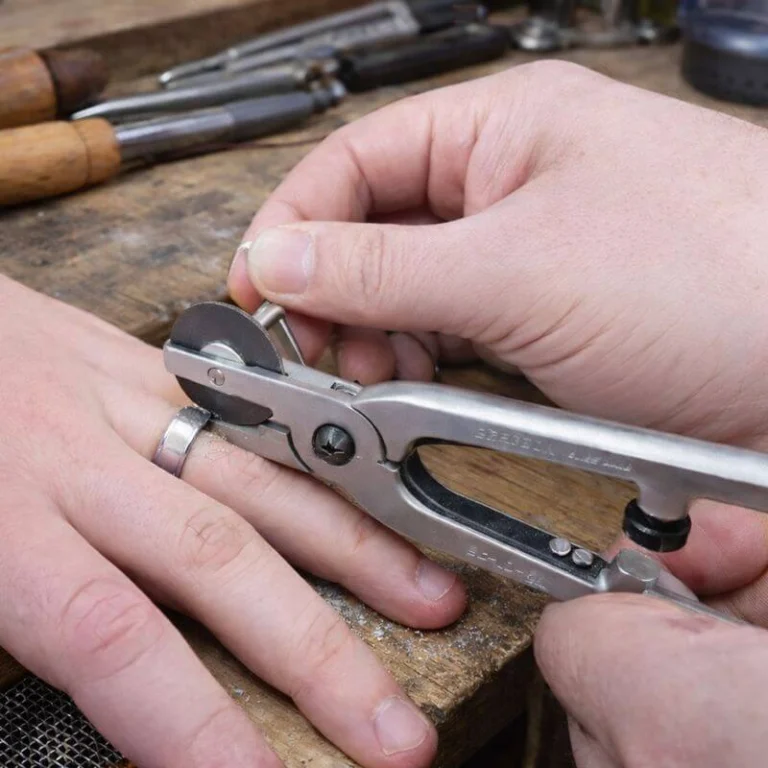
Precious metal rings are normally removed by cutting.
- One cut is usually sufficient
- The ring is then opened and slid off the finger
Where practical, cutting through a plain section preserves any hallmark or engraving for potential repair and avoids the need for re-hallmarking.
After the initial cut, the ring is opened by spreading rather than levering. In a workshop setting, two pairs of jewellers’ half-round pliers are typically used, one on each side of the cut, to open the ring evenly.
In an emergency, any thin pliers that can be positioned safely between the ring and the finger may be used. If the ring resists spreading or places pressure on the finger, a second cut should be made rather than forcing it open.
Why standard ring cutters fail on modern rings
Manual ring cutters designed for precious metals are generally ineffective on alternative metals.
They may work on most titanium rings, but should not be relied upon for cobalt, tungsten carbide, ceramic, or thicker titanium rings. Rotary cutting tools are required for these materials.
How titanium, tantalum, Damascus steel, and zirconium rings are removed
These materials are tough but ductile and are removed by cutting.
- One cut is made using a suitable rotary cutting tool
- The ring is opened and eased off
If the ring is very wide (typically over 8–10mm), thick (over 2–3mm), or too rigid to open safely, a second cut is made opposite the first. This allows the ring to separate into two pieces and fall away.
Diamond-impregnated blades cut faster on harder materials. Continuous cooling with water is important, as many alternative metals conduct heat poorly and heat builds quickly at the cut site.
How cobalt rings are removed
Cobalt rings are tougher than precious metals and cut more slowly.
- A second cut is often required
- Wider rings almost always require two cuts
Diamond-impregnated cutting discs are strongly recommended, as standard steel blades dull rapidly. Continuous cooling with water should be used throughout cutting.
How tungsten carbide and ceramic rings are removed
Tungsten carbide and zirconia ceramic rings are extremely hard but brittle. They are not removed by cutting.
They are fractured by controlled stress.
- The ring rests directly against a solid metal surface with no cushioning material between ring and surface
- A controlled strike is applied, using moderate force for thin rings and progressively firmer force for thicker bands
- Multiple measured strikes are safer and more effective than a single heavy blow
- The ring is rotated slightly between strikes
The finger remains inside the ring but does not bear the impact force. All energy is absorbed by the ring structure. When the stress limit is reached, the ring fractures and breaks apart.
When the correct technique and tools are used, tungsten carbide and ceramic rings can often be removed quickly.
Safety when cutting outside a medical setting
When cutting is carried out outside a hospital or emergency department, a physical guard should be used.
The bowl of a teaspoon rests against the palm while the handle slides under the ring, with the curved side of the handle toward the finger. This protects the skin during cutting.
If pain increases, circulation changes, or swelling worsens, removal should stop and professional help should be sought.
How material behaviour is confirmed in practice
Once cutting or stressing begins, material behaviour becomes clear within seconds.
- Rings that cut easily and spread behave like precious metals
- Rings that cut slowly and resist spreading behave like titanium, cobalt, tantalum, or steel
- Rings that resist cutting and fail suddenly behave like tungsten carbide or ceramic
At this point, selecting the correct removal method matters more than identifying the exact alloy.
Support and guidance
Every jewellery material used in modern rings has an established removal technique.
Emergency departments, fire services, medical professionals, and jewellers who require guidance on identifying ring materials or selecting an appropriate removal method are welcome to contact us for practical advice based on real-world experience.





 Winner of King award for Alternative Metal Rings
 Winner of Theo Paphitis (Dragons Den) Small Business Award
 We are fully pci-dss compliant
 Security Headers rate us A+ for website security
 We are registered with the ico for data protection
 We are members of The Guild of Jewellery Designers