Free UK Delivery | 30 Days Return Policy

Cobalt Rings Pros and Cons: A Technical Guide

Cobalt Chrome Alloy as a Jewellery Material

Cobalt Chrome Alloy as a Jewellery Material

Cobalt-chromium-molybdenum alloy entered jewellery through a very different route from traditional precious metals. Gold and platinum were valued first for appearance and rarity, with their mechanical properties adapted later for jewellery use. Cobalt chrome followed the opposite path. It proved itself in demanding industrial and medical environments long before it appeared on a jeweller’s bench.

In the UK jewellery trade, this material is commonly described as cobalt metal rings or simply cobalt rings, even though cobalt chrome is the correct technical term. The distinction matters less in practice than understanding how the alloy behaves and why it performs the way it does when worn as a ring.

Quick Summary

Cobalt rings pros and cons are defined by engineering decisions made decades before jewellery adoption. The alloy was designed to tolerate continuous load, repeated stress, and corrosive environments over long periods of time. When adapted for rings, those same properties translate into high structural stability, resistance to surface wear, and a naturally bright white appearance without surface coatings.

In our workshop, cobalt rings sit alongside titanium, tungsten, tantalum, and zirconium. Each occupies a distinct position among alternative metals. Cobalt chrome stands out for its combination of toughness, brightness, and predictability in daily wear.

Industrial and medical context

Cobalt-chromium-molybdenum alloys are most closely associated with medical implants. Hip joint replacements, knee components, and dental implants are routinely manufactured from this alloy because it combines high strength with excellent fatigue resistance and corrosion stability. These implants are designed to remain inside the human body for decades while being subjected to constant movement and load.

In hip replacements, the alloy must withstand repeated compressive forces while maintaining a smooth, wear-resistant surface. Chromium plays a central role by forming a stable chromium oxide layer that protects the underlying metal from corrosion. Molybdenum improves strength and resistance to pitting, particularly in chloride-rich environments such as bodily fluids. Cobalt provides the base strength and fatigue resistance that allow the alloy to tolerate millions of loading cycles without cracking.

Dental implants and crowns rely on the same principles. The material must remain dimensionally stable, resist corrosion from saliva and food acids, and tolerate constant micro-movement over long periods. These requirements closely mirror the demands placed on a ring worn every day.

Beyond medicine, cobalt alloys are used in aerospace applications, particularly in turbine components and high-temperature environments. In these settings, the alloy must retain strength, resist deformation, and tolerate thermal cycling without fracture. The fact that the same alloy family is trusted in aircraft engines and permanent implants explains why it performs reliably as a jewellery material.

For a jewellery workshop, this industrial background is not abstract. It explains why cobalt rings behave consistently during engraving, finishing, and long-term wear, and why they respond differently to impact and surface wear than more brittle materials.

Alloy composition and material science

Cobalt metal rings are produced from a cobalt-chromium-molybdenum alloy with a typical composition of approximately 60–65 percent cobalt, 25–30 percent chromium, and 5–7 percent molybdenum. Trace elements may be present depending on the exact formulation, but the performance of the alloy is governed by this core composition.

Chromium is responsible for corrosion resistance through the formation of a passive oxide layer on the surface. This oxide is stable, adherent, and self-limiting, meaning it protects the metal without flaking or degrading. Molybdenum contributes to strength and resistance to localised corrosion, particularly pitting. Cobalt provides the base structure, delivering high fatigue resistance and toughness.

Nickel content is typically below 0.5 percent. This is significantly lower than many white gold alloys. Nickel is tightly bound within the alloy matrix, and the chromium oxide surface layer further limits nickel release.

These material characteristics explain many of the practical cobalt rings pros and cons observed in wear.

Manufacturing methods

Cobalt chrome jewellery alloys can be cast or forged using conventional metalworking techniques. Unlike ceramic-based materials such as tungsten carbide, cobalt alloys can be machined, drilled, and engraved without fracturing.

Ring blanks are typically cast or forged close to final shape, then machined and finished to precise dimensions. Heat treatment may be used to optimise strength and microstructure, depending on the manufacturing route.

In practical terms, cobalt rings arrive at the workshop as finished or semi-finished products. Structural changes such as resizing are not offered, but surface finishing and engraving are carried out in-house. The ability to machine and engrave the alloy cleanly is one of its advantages compared with harder but more brittle alternatives.

Workshop experience and real-world wear

In our workshop, we engrave and finish cobalt rings daily. We also see rings return after months or years of wear, which provides a clear picture of how the alloy performs outside controlled conditions.

Surface wear develops more slowly than on traditional precious metals. Scratches do occur, but they appear gradually and tend to be finer and less visually disruptive. The alloy does not chip, crack, or shatter under normal impacts, which distinguishes it from ceramic-based materials.

These observations align closely with the alloy’s industrial role. Cobalt chrome is designed to absorb energy and tolerate repeated stress rather than fail through brittle fracture. This toughness is one of the most significant advantages when assessing cobalt rings pros and cons for active lifestyles.

Hardness, weight, and physical properties

Cobalt metal rings typically measure between 380 and 450 HV on the Vickers hardness scale. For comparison, Grade 5 titanium is around 340 HV, while 18ct gold and platinum generally fall between 125 and 170 HV. This places cobalt chrome among the harder jewellery alloys, offering strong resistance to surface wear without the brittleness associated with ceramics.

Density is approximately 8.5 g/cm³. This positions the alloy between titanium at around 4.5 g/cm³ and platinum at approximately 21.5 g/cm³. In wear, the ring feels solid and substantial without being excessively heavy.

The melting point of cobalt is approximately 1495°C. While the alloy melts over a range rather than at a single temperature, this figure helps explain why cobalt can be cast and machined using established jewellery techniques.


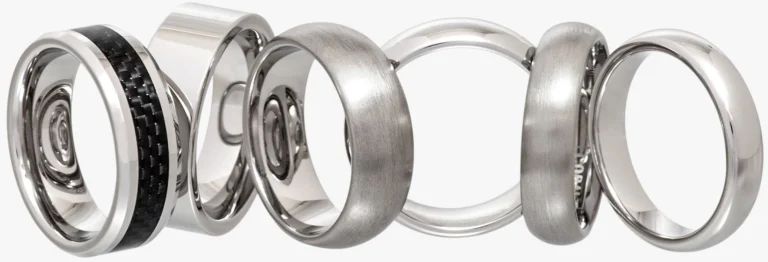
a selection of Cobalt Metal Rings from our range.

Colour and appearance stability

Cobalt rings have a naturally bright white appearance. The colour is inherent to the alloy and does not rely on surface coatings or plating. No rhodium plating is required, and there is no finish layer to wear away over time.

Compared with platinum, the tone is slightly warmer, though the difference is subtle. Compared with titanium, cobalt appears noticeably brighter and less grey. The colour does not yellow, tarnish, or oxidise during normal wear.

This stable appearance is one of the main reasons cobalt wedding rings appeal to those who want a white metal ring without ongoing plating maintenance.

Sizing limitations

Cobalt rings cannot be resized. The same hardness and strength that give the alloy excellent durability make traditional resizing methods impractical.

Accurate sizing before manufacture is therefore essential. Ring width has a direct effect on perceived fit, with wider bands feeling tighter than narrow ones of the same nominal size. This should be finalised before sizing is confirmed.

Cobalt rings are typically available in a wide size range, including larger sizes, which helps accommodate correct fit without relying on resizing.

Engraving performance

Cobalt rings engrave cleanly using fibre laser systems. Standard engraving produces a crisp, precise mark that appears lighter than the surrounding metal, making internal text easy to read.

In our workshop, engraving is carried out using a JPT 80W MOPA fibre laser. This allows fine control over power, pulse width, and engraving speed. A black engraving option is also available, created through multiple passes that chemically alter the surface via controlled oxidation.

This darker engraving effect is relatively new. Long-term wear data is limited, and it should not be described as permanent. If the darkened colour fades over time, the engraving itself remains intact and simply returns to the standard engraved appearance. More detail is covered in the laser engraving guide.

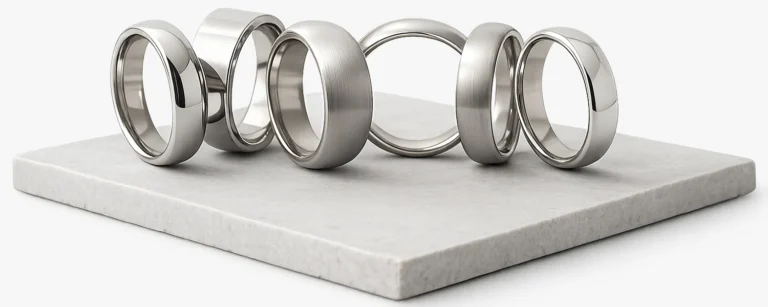
Five cobalt chrome wedding rings in alternating polished and brushed satin finishes
A selection of polished and brushed cobalt chrome wedding rings

Surface finishes and long-term wear

Cobalt rings are typically offered in polished or brushed finishes.

A polished finish produces a high mirror shine. Once surface scratches appear, the finish cannot be traditionally re-polished. The only practical change is conversion to a brushed finish. A brushed finish introduces a satin texture that diffuses light and reduces the visibility of surface marks. Brushed finishes can be refreshed but cannot be converted back to polished.

Finish changes are one-way only. Polished can be converted to brushed, but brushed cannot be returned to polished. This is an important consideration when selecting finish at the outset.

Examples can be seen on the polished cobalt ring and brushed cobalt ring pages.

Durability and mechanical behaviour

Cobalt rings do not shatter, crack, or fracture under normal impacts. The alloy has excellent toughness and fatigue resistance, which is why it is trusted for load-bearing medical implants.

This makes cobalt rings suitable for active lifestyles, including gym training, manual trades, and outdoor work. They retain structural integrity under stresses that can damage more brittle materials.

From a practical standpoint, cobalt chrome sits at the tougher end of the alternative metals spectrum.

Safety and biocompatibility

Cobalt-chromium alloys are approved for permanent medical implants, indicating high biocompatibility. Nickel content is low, typically below 0.5 percent, and is tightly bound within the alloy matrix.

The chromium oxide surface layer further reduces nickel release. The material complies with UK nickel release regulations for prolonged skin contact. Most people tolerate cobalt rings well, though individual sensitivity varies. Anyone with a severe nickel allergy should consult a medical professional before choosing any metal ring.

The alloy does not tarnish and will not discolour the skin.

Comparisons with other metals

When comparing cobalt rings vs titanium, cobalt is harder and more scratch resistant, with a brighter white appearance. Titanium is lighter and more flexible but shows surface wear more quickly.

Compared with tungsten rings, cobalt is less hard but significantly tougher. Tungsten carbide resists scratching more effectively but can fracture under sharp impact. Cobalt absorbs energy and can be cut in an emergency.

Against white gold, cobalt maintains its colour without plating and is more resistant to surface wear. White gold can be resized, whereas cobalt cannot. More detail on plating behaviour is covered in the rhodium plating guide.

Platinum is softer and develops surface marks more readily. It can be resized and has a similar natural white appearance. Cobalt offers greater surface durability and a lower material cost.

Emergency removal

Cobalt rings can be cut off in a medical emergency. Standard hospital ring cutters fitted with hardened steel or diamond-impregnated blades are effective, though cutting can be slower than with softer metals.

This predictable cutting behaviour is one of the practical advantages of cobalt over ceramic-based materials.

Understanding cobalt rings pros and cons

Cobalt rings pros and cons are defined by durability and practicality rather than flexibility. The alloy offers high resistance to surface wear, a stable white colour without plating, excellent toughness, and good biocompatibility. It engraves cleanly, does not shatter, and performs reliably in demanding environments.

The limitations are equally clear. Cobalt rings cannot be resized. Polished finishes cannot be restored once scratched, and finish changes are one-way. Colour options are limited to natural white, and emergency removal requires appropriate cutting equipment.

Understanding these characteristics allows informed decisions based on material behaviour rather than marketing claims.

UK Based Stock

We dispatch directly from our Kent Location.

Fast Dispatch

Stock orders placed by 1pm usually sent same working day

Easy Returns

30 day no quibble refund or exchange policy

Expert Support

Speak to our Goldsmith with over 35 years jewellery experience