
Free UK Delivery | 30 Days Return Policy

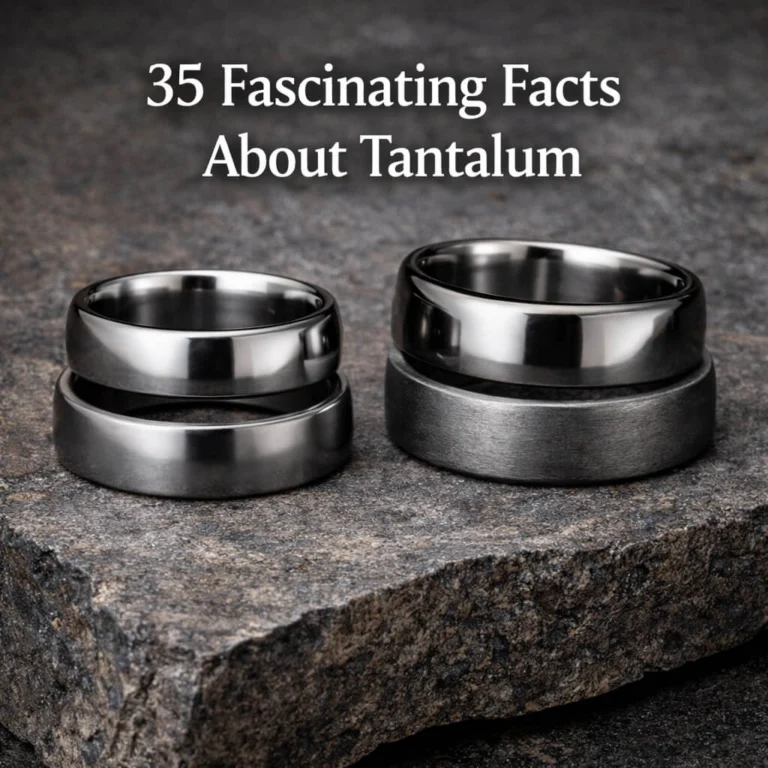
35 Fascinating Facts About Tantalum

Published: 25 April 2025 | Updated: 31 January 2026 | Author: Jason Beer | Estimated Reading Time: 4 min
.

Some Facts about Tantalum Rings

Some Facts about Tantalum Rings

Tantalum is one of the least familiar metals used in modern jewellery, yet it has properties that make it unusually well suited to long-term wear. Outside jewellery, it is widely used in medical, aerospace, and electronic applications where stability matters more than appearance.

The facts below explain what tantalum is, how it behaves, and why it differs from more familiar ring materials.

Origin and Material Background

  1. Tantalum is a rare metallic element, significantly less abundant in the Earth’s crust than gold.

  2. It is primarily sourced from columbite-tantalite ores, often alongside niobium.

  3. Commercial mining is limited to a small number of regions worldwide, including parts of Africa and Australia.

  4. The metal was identified in 1802 by Swedish chemist Anders Ekeberg.

  5. Its name comes from Tantalus, a figure in Greek mythology, reflecting the metal’s resistance to chemical attack.

  6. Jewellery-grade tantalum is typically very high purity rather than heavily alloyed.

  7. Because of its specialised industrial uses, tantalum is not commonly recycled in the jewellery sector.


Physical Characteristics

  1. Tantalum has a naturally dark grey to blue-grey colour without surface plating or coatings.

  2. That colour is intrinsic to the metal and does not wear away during normal use.

  3. It is notably dense, giving it a heavier feel than titanium or stainless steel. Many people describe this weight as reassuring rather than cumbersome.

  4. Unlike brittle materials, tantalum is tough and can deform slightly under extreme stress instead of fracturing.

  5. Its melting point exceeds 3,000°C, far higher than traditional precious metals.

  6. When polished, the surface feels smooth and low-friction rather than glassy or sharp.

  7. Brushed, matte, and textured finishes can be applied without coatings or surface treatments.

  8. Over time, surface wear tends to develop gradually rather than through chipping or cracking.


Wear Behaviour and Stability

  1. Tantalum is highly resistant to corrosion and does not rust.

  2. It remains stable in contact with moisture, sweat, and everyday environmental exposure.

  3. Unlike silver, it does not tarnish or discolour with normal wear.

  4. The metal is non-magnetic.

  5. It conducts heat poorly, which means it does not feel excessively cold in winter or hot in summer.

  6. Scratches can occur, but they typically appear as soft surface marks rather than sharp damage.

  7. The combination of density and toughness contributes to a balanced, solid feel during daily wear.


Skin Contact and Safety

  1. Tantalum is biocompatible and has long been used in medical implants.

  2. It is considered hypoallergenic and suitable for prolonged skin contact.

  3. Chemically, the metal is highly inert under normal conditions.

  4. It does not readily release ions when worn against the skin.

  5. Tantalum is non-toxic and safe for use both externally and internally.


Manufacturing and Practical Considerations

  1. Tantalum rings are difficult to machine compared to traditional jewellery metals. This is due to its toughness and resistance to heat.

  2. Specialised tooling is required, particularly for cutting and shaping.

  3. Resizing tantalum rings is technically possible in limited cases, but it is more complex than resizing gold or platinum.

  4. Laser engraving is commonly used because the metal responds cleanly and consistently.

  5. Conventional casting and soldering methods are generally unsuitable due to the metal’s chemical stability.


Uses Beyond Jewellery

  1. Tantalum is a critical material in electronic capacitors used in phones, computers, and medical devices.

  2. It is used in aerospace and defence applications where heat resistance and long-term stability are required.

  3. These same properties—toughness, corrosion resistance, and chemical stability—explain why tantalum performs well as a long-term jewellery material.


Final note

Tantalum is not chosen because it imitates traditional precious metals. It behaves differently, wears differently, and requires different expectations. Understanding those differences matters more than trends, labels, or conventio

Share this blog post
Author: Jason Beer
Jason Beer
Owner

Goldsmith with 38 years’ bench experience. I started repairing jewellery for leading high-street chains, then joined an independent jeweller in 1994, specialising in turning old gold into bespoke pieces. In 2009 I became co-owner and built the firm into one of Maidstone’s most respected jewellers. After selling the business to the team in 2025, I now run Titan Jewellery’s workshop full-time. I’ve worked with alternative metals since 2002 and launched TitanJewellery.co.uk in 2012 to showcase titanium and other modern materials.

More articles on this topic
Recent articles

Sellerdeck to Woocommerce

Sellerdeck to WooCommerce: Our Journey From Sellerdeck to WooCommerce: Why We Finally Moved After 23 Years I have worked with Sellerdeck websites for 24 years. When…
Choosing a Titanium Ring in 2026

Why so Many People Are Choosing a Titanium Ring in 2026 Why Titanium Rings Have Gone Mainstream Titanium rings are no longer a niche choice. In…
Palladium Wedding Ring Information

Palladium Wedding Ring Information Palladium Wedding Rings: What You Need to Know Palladium wedding rings were once promoted as a practical alternative to platinum. For a…

UK Based Stock

We dispatch directly from our Kent Location.

Fast Dispatch

Stock orders placed by 1pm usually sent same working day

Easy Returns

30 day no quibble refund or exchange policy

Expert Support

Speak to our Goldsmith with over 35 years jewellery experience